
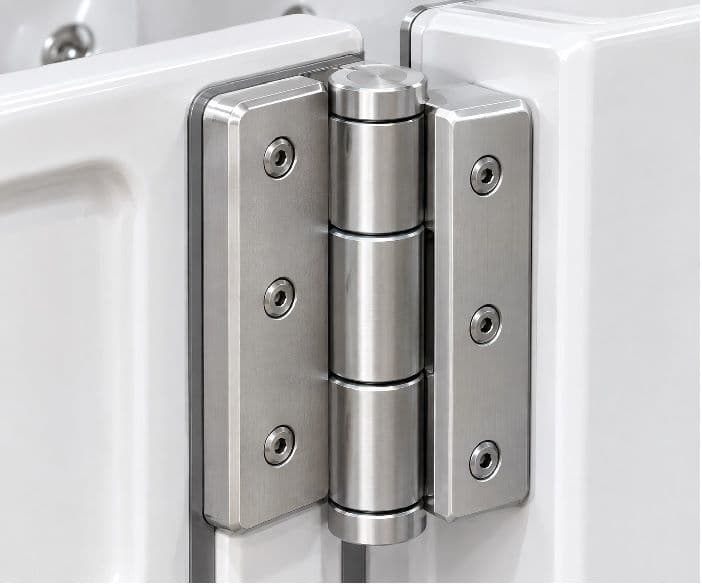
When people shop for a walk-in bath, they naturally focus on the big features — the low step-in threshold, the comfortable seat, the therapeutic jets. The door, however, is arguably the most safety-critical component of the entire design. And at the heart of every reliable walk-in bath door are its hinges. Reinforced hinges are what separate a door that performs flawlessly for decades from one that gradually weakens, warps, or — in the worst case — fails at exactly the wrong moment.
What Are Reinforced Hinges and Why Do They Differ?
A standard domestic door hinge is designed to support a lightweight panel swinging in dry, stable conditions. A walk-in bath door hinge faces an entirely different set of demands. It must bear the weight of a thick, sealed acrylic or fibreglass panel — often considerably heavier than it looks — while operating in a permanently humid, thermally fluctuating environment. It must create and maintain a watertight seal every single time the door closes, and it must do this reliably thousands of times over the lifespan of the bath.
Reinforced hinges are engineered specifically for this environment. They are typically constructed from marine-grade stainless steel or heavy-duty brass alloys, both chosen for their resistance to corrosion in wet conditions. The pivot points are wider and the mounting plates thicker, distributing the load of the door panel across a greater surface area rather than concentrating stress at a few small fixing points. The result is a hinge mechanism that simply does not flex, shift, or degrade under the repeated thermal and mechanical stress of daily use.
Built to Last Decades, Not Just Years
One of the most important qualities of a quality walk-in bath is longevity. For many older adults and their families, purchasing a walk-in bath is a significant investment — one that is expected to last well into the future without requiring major repairs or replacements. Reinforced hinges are central to delivering that longevity.
Weaker hinges made from lower-grade metals are prone to a gradual process of micro-movement — tiny shifts in alignment that occur each time the door is opened and closed. Over months and years, these micro-movements accumulate. The door begins to hang slightly out of true, the seal no longer compresses evenly, and small leaks develop around the edges. Eventually, the hinge mechanism itself may crack or seize entirely.
Reinforced hinges eliminate this degradation path. Their rigid construction means the door hangs in exactly the same position on day one as it does on day one thousand. The seal remains consistent, leaks do not develop, and the entire door mechanism continues operating with the same smooth, dependable action it had when new. For a product that will be used at least once — and often twice — every single day, this mechanical consistency is not a luxury. It is essential.
The Safety Case: Preventing a Trapped User
This is the concern that matters most. A walk-in bath is filled with water after the user has entered and the door has been closed. This is a fundamental difference from a conventional bath. If the door fails while the bath is in use, the user cannot simply step out — the bath must first be drained before the door can be safely opened. A door mechanism that jams, stiffens, or fails entirely in this situation does not just cause inconvenience. It can trap a vulnerable person, alone and potentially undressed, in a filling or filled bath.
For elderly users — particularly those with limited strength, reduced grip, or conditions such as arthritis — a stiff or malfunctioning door latch becomes a genuine emergency. The risk of panic, overexertion, or a fall while attempting to force a door open are all real dangers. In more serious scenarios, particularly where the user is bathing alone, a failure to exit promptly could have severe consequences.
Reinforced hinges directly address this risk. Because they maintain precise alignment throughout the lifespan of the bath, the door continues to open and close with consistent, light effort. There is no progressive stiffening, no drooping that causes the door to bind in its frame, and no sudden mechanical failure. The locking and release mechanism operates as intended every time, regardless of how many years have passed. This reliability is not incidental — it is the primary safety argument for specifying reinforced hinges in any walk-in bath intended for elderly or mobility-impaired users.
Maintaining a Watertight Seal Year After Year
The door seal on a walk-in bath is only as good as the hinge holding the door in position. A seal is designed to compress evenly along its entire length when the door is closed, creating a continuous watertight barrier. If the hinge allows the door to sag even fractionally — whether due to metal fatigue, corrosion, or simple wear — the seal no longer meets the frame uniformly. Water finds the weakest point and begins to seep through.
This is a problem that compounds over time. A minor leak accelerates the corrosion of surrounding components, softens the flooring beneath, and creates slip hazards. It also signals to the user that the bath is beginning to fail — eroding their confidence in a product that should be a source of independence and comfort, not anxiety. Reinforced hinges, by keeping the door perfectly aligned at all times, ensure the seal performs exactly as specified for the life of the bath. There are no drips, no damp patches on the bathroom floor, and no creeping sense that something is about to go wrong.
Aesthetics That Hold Up Over Time
A walk-in bath is a permanent fixture in the home, and homeowners rightly expect it to look as good in ten years as it does on installation day. This is another area where hinge quality makes a visible difference. Lower-grade hinges are prone to surface corrosion, tarnishing, and discolouration — particularly in the warm, steamy environment of a bathroom. Chrome finishes peel or pit, brass equivalents develop a dull, uneven patina, and the overall appearance of the door assembly begins to look neglected regardless of how carefully the bath itself is maintained.
Reinforced hinges fitted on quality walk-in baths use surface treatments and alloy compositions specifically chosen to resist the bathroom environment. Marine-grade stainless steel, for instance, retains its finish without polishing or special maintenance. The hardware continues to look clean, precise, and well-engineered — in keeping with the aesthetic of a premium product. Beyond surface finish, because reinforced hinges hold the door perfectly in place, the door itself does not begin to look askew over time. Gaps do not open up between the door and the frame. The overall geometry of the bath remains symmetrical and intentional, exactly as designed.
What to Look for When Choosing a Walk-In Bath
When evaluating walk-in baths, it is worth asking specific questions about hinge construction rather than accepting vague reassurances about quality. The key indicators of a well-engineered hinge assembly are the material specification (marine-grade stainless steel or equivalent), the thickness of the mounting plates, whether the pivot mechanism is sealed against moisture ingress, and the manufacturer's stated cycle life — the number of open-and-close operations the hinge is rated to withstand.
It is also worth considering what happens if the door does need attention years down the line. Quality manufacturers design their hinge systems to be serviceable — meaning individual components can be adjusted or replaced without requiring a full door or bath replacement. This repairability is another mark of a product engineered for the long term rather than built to a minimum acceptable standard.
Frequently Asked Questions
How long should a walk-in bath door hinge last?
A properly reinforced hinge on a quality walk-in bath should last the full lifespan of the product — typically 15 to 25 years or more with normal daily use. The hinge should not require replacement or adjustment during this period if it has been correctly specified and installed.
Can a walk-in bath door trap someone inside?
A poorly maintained or low-quality door mechanism can indeed become difficult or impossible to open if the hinge fails or the door drops out of alignment. This is precisely why reinforced hinges are so important — they maintain consistent alignment and easy operation throughout the life of the bath, eliminating the risk of a door that jams or binds when it matters most.
What material should walk-in bath hinges be made from?
Marine-grade stainless steel is the gold standard for walk-in bath hinges, offering excellent corrosion resistance, structural strength, and a finish that does not degrade in a humid bathroom environment. Heavy-duty brass alloys with appropriate protective coatings are also used in premium products. Both outperform standard chrome-plated steel, which is prone to rust and surface degradation over time.
Will a sagging door affect the watertight seal?
Yes — even a very small amount of door sag can break the even compression of the door seal, creating gaps through which water will leak. Because the seal relies on uniform contact along its full length, the precision alignment provided by reinforced hinges is essential for keeping it working correctly over time.
Do Odyssey Baths walk-in baths use reinforced hinges?
Yes. All Odyssey Baths walk-in baths are fitted with reinforced, heavy-duty door hinges as standard. Our door assemblies are engineered to maintain a precise, watertight seal throughout the life of the product, giving users and their families complete confidence in the safety and reliability of the bath every time it is used.
Written by Odyssey Experts
Our advice is based on years of experience helping UK families find safe bathing solutions. We ensure all our guides align with current UK regulations and industry best practices.